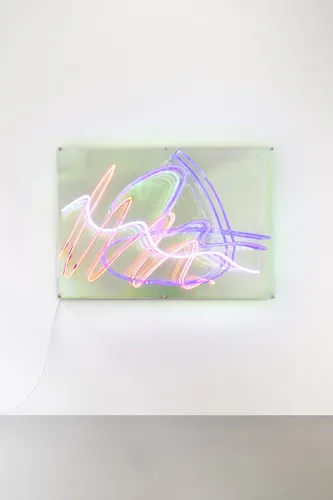
My morning begins with one of two possible rituals. Option one is to be awakened by the phrase, "Mom, I want milk," shouted by my three-year-old. Option two is that the phrase, "more real than reality itself," mixes in with the dream. "At one point in the early years in Paris when he was feeling extremely discouraged/He was just getting nowhere" a beautifully formed woman's voice says the words, which feel like a kind of catchy slogan, on top of a cheesy beat, in the morning in my home:
And he went to see Picasso, and Picasso said
"Get in line, which turn? Just pretend you're waiting for the subway"
At the same time the art itself, the product of that obsession
That obsessive kind of way of working
Is the paradigm for all that is free and spontaneous
Then the alarm turns off. The lyrics are sampled from a talk by the curator at the Museum of Modern Art, Carolyn Lanchner, about the surrealist Spanish artist Joan Miró. I feel that the text describes what it feels like to make art. You must get started on your calling, wake up. Wake up to yet another day where you must try your best and endure rejection, because art is your calling. I have often come to ideas through dreams. Dreams that feel more real than reality.
My installations are approximations of the feeling of entering a dreamscape. Dreams know no boundaries: they magnify or diminish things, distort them, or pull you inside them. Sometimes they appear as sounds or fleeting images. I never write them down, new ones come all the time anyway. There is no hierarchy between night dreams, daydreams, or night terrors; they exist even though I fear some of these states.
I can't help daydreaming. I just sit there on the train and start laughing. My partner knows this, so he looks at me and asks me what I'm thinking about. He can tell when I'm lying, so I just tell him the truth, even when it's somehow lame. I might be imagining a six-meter-long recorder. Or wondering what would happen if I sawed brass instruments apart and reassembled them using radiator fittings, turning standardized objects into modular ones. Listening to intuitions.
As the American conceptual artist Adrian Piper wrote in 1996:
"It seemed that the more clearly and abstractly I learned to think, the more clearly I was able to hear my gut telling me what I needed to do, and the more pressing it became to do it."
How does one listen to the gut? Would you have to tear out the gut and create strings to mount on a violin and play them in order to hear it? Listening to the gut is about responding to the body, to something that insists before it can be explained.
I think of this as being close to the logic of dreams. Dreams do not argue for themselves. They simply present something: an image, a sound, a strange connection between things that should not belong together. It feels necessary, it sometimes even feels more real than reality itself.
When Piper writes about hearing what her gut was telling her more clearly, the more abstractly she learned to think, it suggests that intuition is not something mystical, but something that can be practiced. Something that might at first sound banal - listen to your gut, follow your dreams - is in practice a much more complicated skill than one might expect.
Flutes are part of the cultural perception of magical objects, for example, in Mozart's The Magic Flute (1791). We all know the traditional German folktale of Pied Piper of Hamelin, a tale occupying the liminal space between fact and fiction, of a flute player freeing the city of Hamelin from its rat infestation, by luring the rats into the river with his magic flute. In Greek mythology, Syrinx was a beautiful nymph pursued by the lustful god Pan in an erotic chase. According to the myth, Syrinx fled to the river, where she was transformed into a cluster of marsh reeds as Pan reached her, and from those reeds, Pan recomposed a body, the panpipe, named Syrinx in her honor.
Bone whistles have historically been used in shamanic rituals as objects endowed with supernatural power in different cultures. All over the world, flutes are imagined as magical, erotic-spiritual agents in myths and folktales. First, they are breath instruments, closely tied to the body, that is animating them by breathing air into them. Secondly, they are associated with alluring melodies, and lastly, their tones and overtones carry far and work subconsciously. I must confess, since my first recorder lesson, I have been haunted by the flute; it keeps returning to me, the interest has become an obsession, the more I try to turn away from the recorder, the more it comes back. It is manifesting itself as a physical presence that is no longer small and ridiculous.
I previously made several artworks with flutes, but "Oops I did it again". My obsession made me want to go bigger: as in monumental, architectural. Next thing I knew was that I had somehow managed to produce a new sculpture: a 6-meter-long recorder, so big that it could not be assembled inside my studio.
The Ghost In The Room (2026), a six-meter-long recorder, capable of playing sub frequencies, like a presence, a vibration. The phenomenon of infrasound has, in several instances, been reported to create an eerie sensation of being in a haunted place, what people describe as the sensation of a presence, a ghost. In a study, researchers show how a room that was allegedly haunted by ghosts was in fact haunted by an acoustic phenomenon, a standing wave at 19 Hz, that is, an infrasound. An infrasound is a sound that is so low-frequency that it is outside what a human can hear, but instead is sensed. In this case, various employees in the laboratory sensed a kind of presence that made them feel that there could be a ghost. In the study, the team of researchers demonstrate how the phenomenon can be explained by the resonant frequency of the eye vibrating under the influence of infrasound, which can create illusions. Furthermore, the researchers describe how infrasound frequencies from 2 to 20 Hz can cause a sensation of discomfort. In The Ghost in the Room, (six-meter-flute), I utilize the concept of infrasound as a compositional tool to make the whole building vibrate or become "alive". In the exhibition More Real than Reality (2026), the flute is installed, yet it does not play, but it has the ability to play, and we can imagine its sounds.
Exhibition text by Ragnhild May
